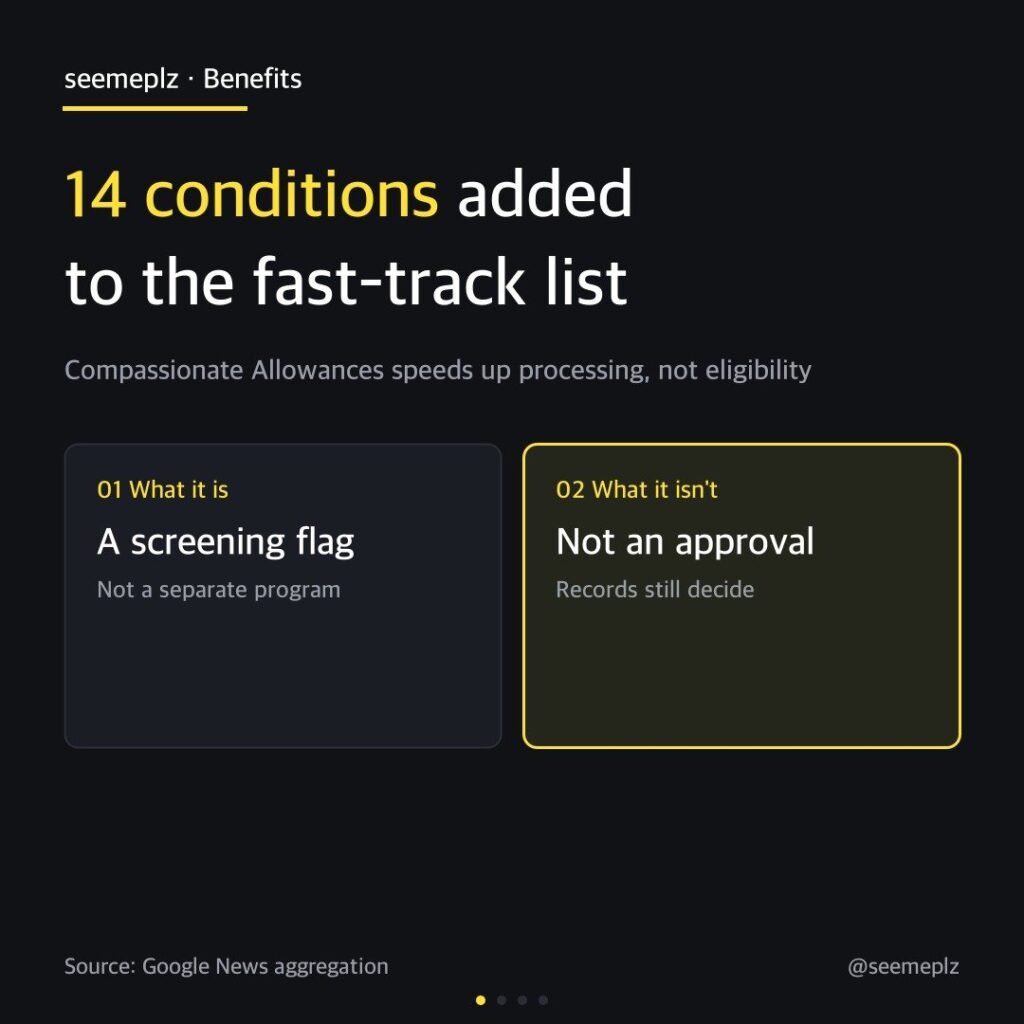

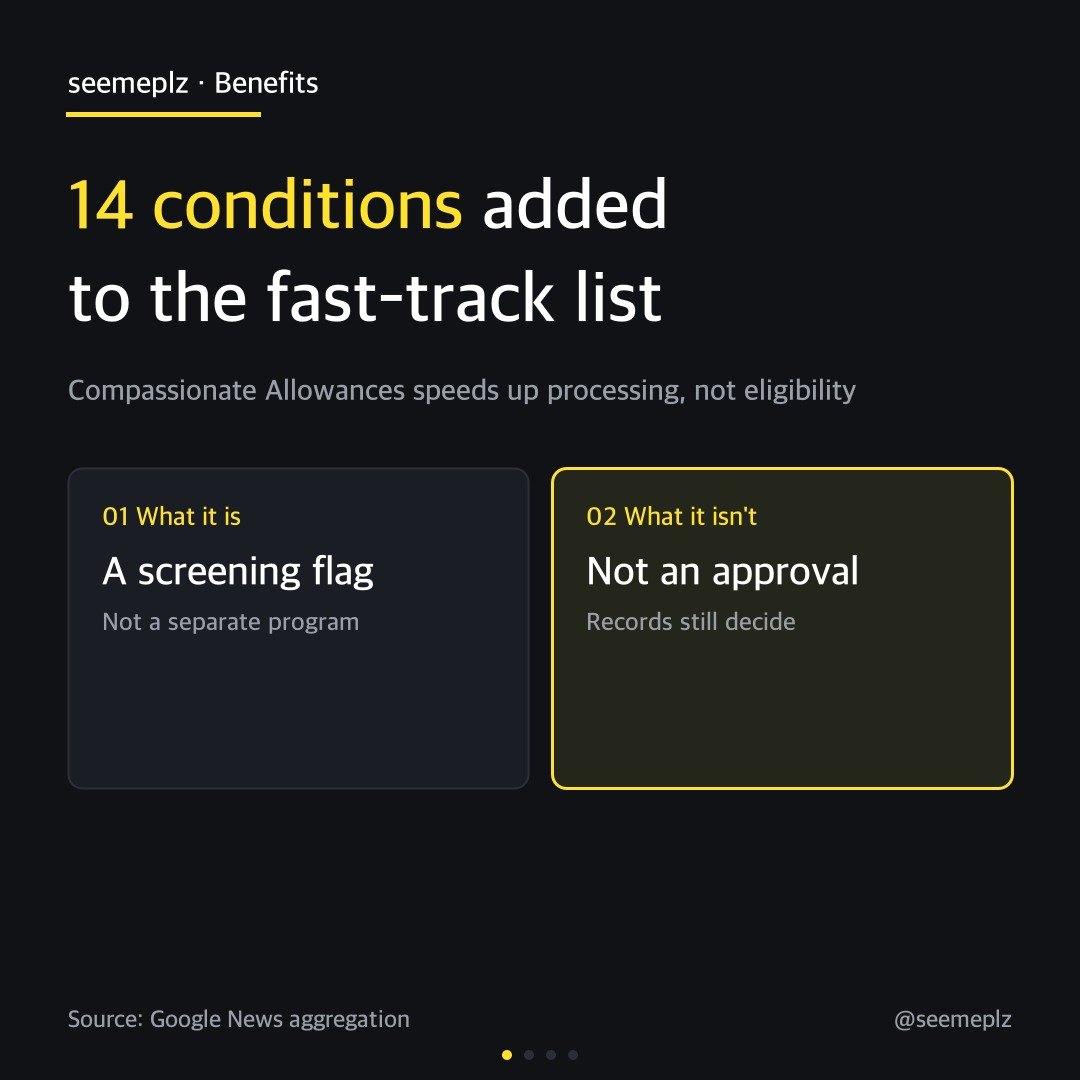
The Social Security Administration has added 14 conditions to its Compassionate Allowances list, a program that flags certain diagnoses for faster processing of disability claims. The announcement matters most to a specific group of applicants, and it is frequently misunderstood by everyone else.
Here is what the program is, what the change does, and — just as important — what it does not do.
What Compassionate Allowances actually is
Disability determinations at Social Security are slow by design and slower in practice. An initial decision commonly takes months, and appeals can stretch far longer. For someone with a rapidly progressing illness, that timeline can outlast the applicant.
Compassionate Allowances exists to address that mismatch. It is not a separate benefit program and it is not a different set of rules. It is a screening mechanism: certain diagnoses are so clearly and severely disabling that, when the medical evidence confirms the diagnosis, the claim can be identified early and moved to the front of the queue.
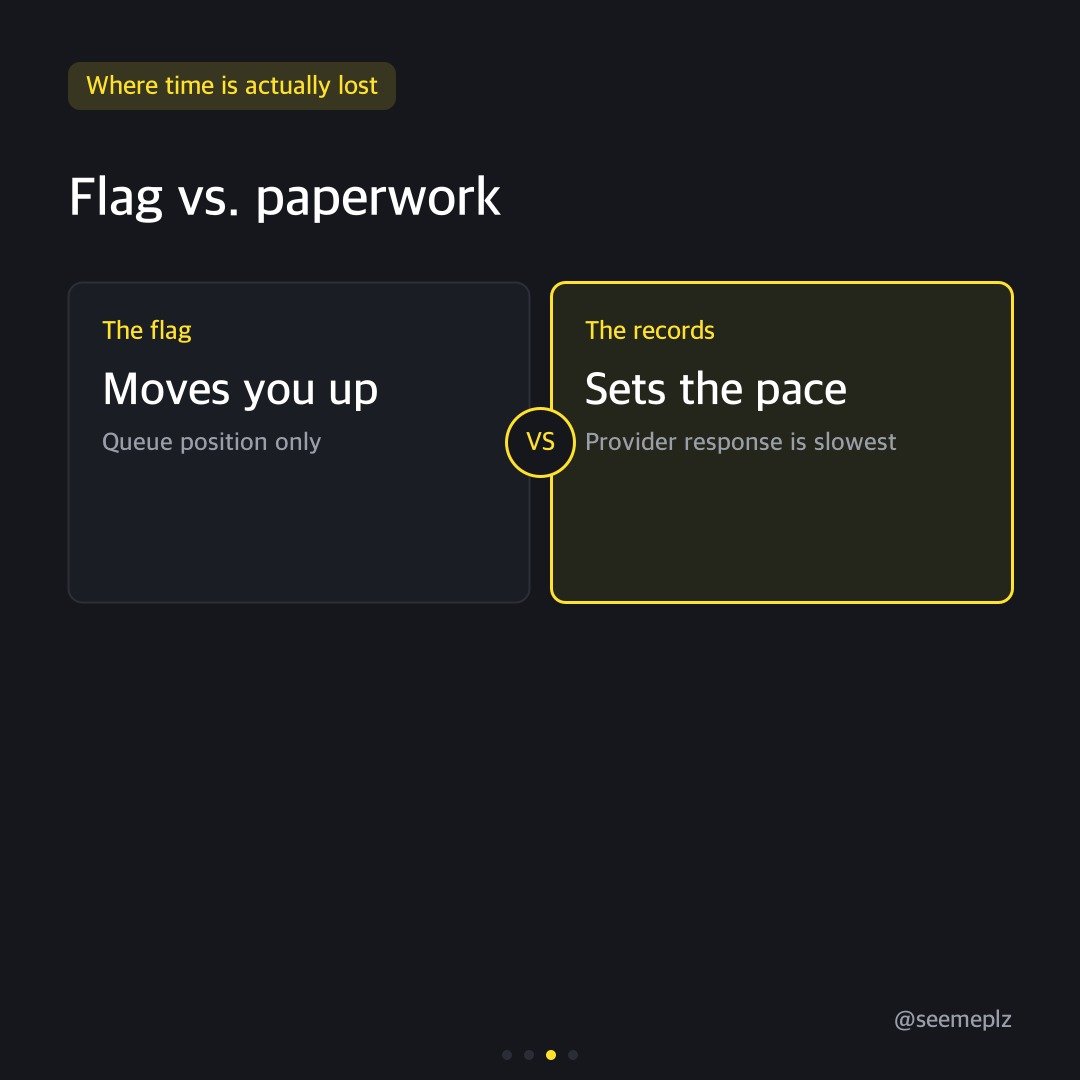
Two things follow from that design. First, the program shortens processing time, not eligibility standards. Second, being on the list does not by itself approve anyone. The agency still needs medical documentation establishing the diagnosis.
What the 14 additions change
Adding conditions to the list expands the set of diagnoses that trigger this expedited handling. For an applicant with one of the newly added conditions, the practical effect is that a claim which previously moved through standard processing may now be flagged for faster review.
The list has grown steadily since the program began, drawing on input from medical experts, advocacy organizations, and public hearings. Most additions are rare diseases, aggressive cancers, and severe congenital disorders — categories where the diagnosis itself is a reliable indicator of functional limitation.
If you or a family member has recently been diagnosed with a serious illness and are considering a disability claim, the specific list is worth checking directly on the agency’s site rather than relying on news summaries. The names used in the official list are precise clinical terms, and a condition may appear under a name different from the one used in everyday conversation.
What applicants still have to do
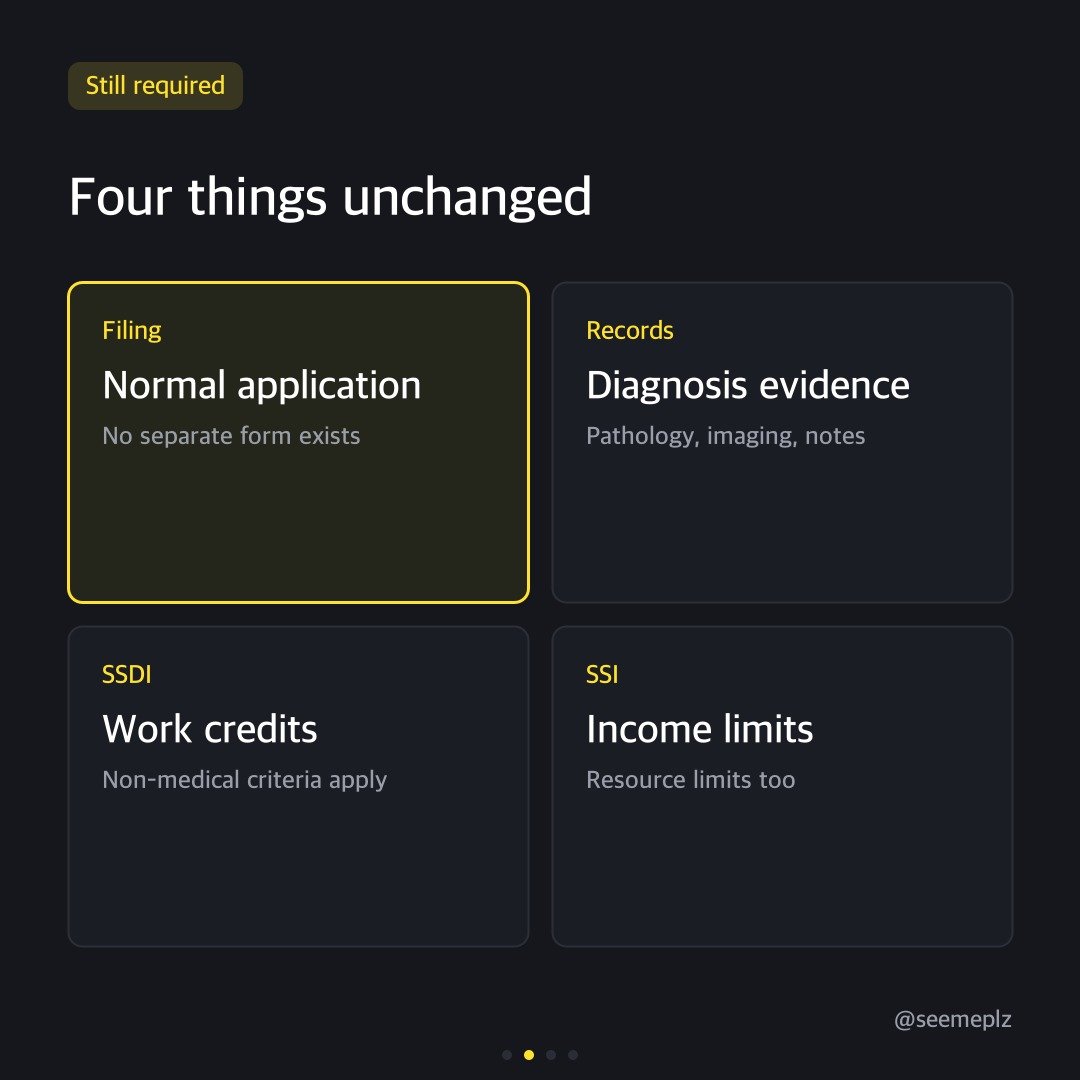
This is the part that gets lost. Compassionate Allowances speeds up a claim; it does not file one. The steps are unchanged.
You still apply through the normal channels. There is no separate Compassionate Allowances application. You file for Social Security Disability Insurance, Supplemental Security Income, or both, using the standard process, and the flagging happens internally based on the medical information provided.
Documentation still determines the outcome. The faster track is triggered by evidence of the diagnosis. That means the claim should include the records that establish it — pathology reports, imaging, specialist notes, and the treating physician’s clinical findings. A claim that names a listed condition without supporting records is not a fast claim; it is an incomplete one.
Non-medical requirements still apply. For SSDI, work credits matter. For SSI, income and resource limits matter. A listed condition does not override those criteria. Applicants are sometimes surprised to learn that a clearly qualifying medical condition can still result in denial on non-medical grounds.
Timelines: what "faster" means in practice
Expedited handling under this program is measured in weeks rather than the months typical of standard processing, though actual timing varies with case complexity and how quickly medical records arrive.
That last point is the one applicants can influence. The agency requests records from providers, and provider response time is often the longest single step. Applicants who bring copies of key records to the application, or who follow up with their providers directly, frequently shorten their own timeline more than any administrative flag does.
Related provisions worth knowing about
Compassionate Allowances is one of several mechanisms for moving urgent claims. Two others come up often enough to mention.
Terminal illness cases are handled under a separate designation that also expedites processing.
Presumptive disability payments apply in certain SSI cases, allowing payments to begin before a final determination in specific circumstances. This is limited in duration and scope, and it does not apply to SSDI.
None of these overlap perfectly, and an applicant may be eligible for handling under more than one. This is a reasonable thing to ask about directly when filing.
If you are helping a family member apply
Most applications under these circumstances are filed with help — by a spouse, an adult child, or a caseworker at the treating hospital. A few things make that process smoother.
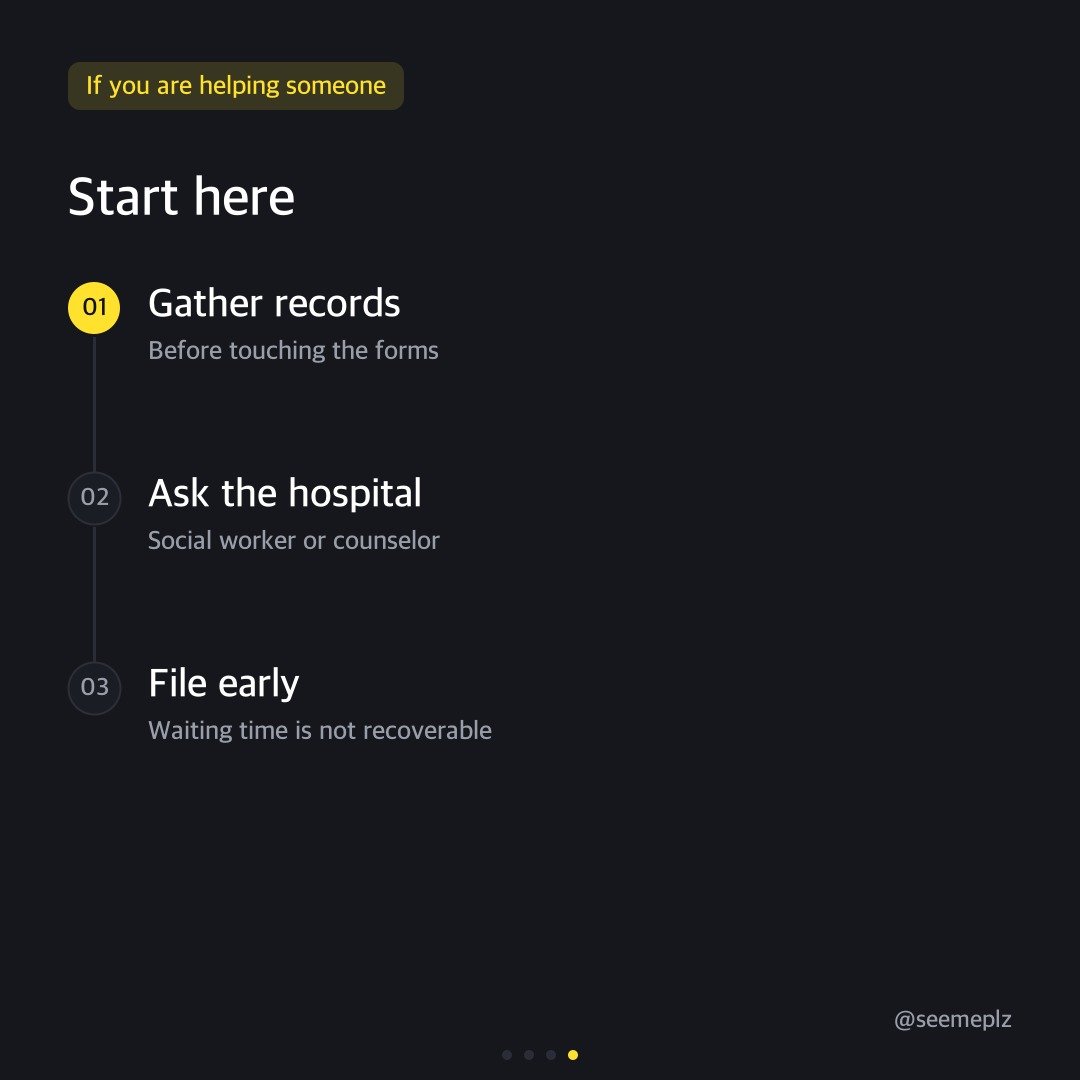
Start with the medical records, not the forms. The single most useful thing a helper can do is assemble the diagnostic documentation before beginning the application. Everything else is data entry.
Ask the treating hospital whether it has a social worker or financial counselor. Large oncology and neurology practices frequently have staff who file these applications regularly and know which records the agency looks for.
Keep a written log of every contact — dates, names, and what was said. If the claim later requires follow-up, that log is worth more than memory.
Finally, apply as early as the situation allows. Benefits generally are not paid retroactively to the date of diagnosis, and for SSDI there is a waiting period built into the law. Time spent waiting to file is rarely recoverable.
The wider context
The steady expansion of this list reflects a structural tension in the disability system: rules written for gradual, long-term impairments applied to conditions that progress in months. The program is an administrative patch, and a reasonable one, but it does not resolve the underlying processing delays that affect every other applicant.
For claims that fall outside the list — the far larger share — the ordinary timeline still applies, and the most effective levers remain complete documentation at filing and prompt response to any request for additional information.
The short version
Fourteen conditions were added to the Compassionate Allowances list, expanding the set of diagnoses that qualify for expedited disability processing. The program shortens the wait; it does not change eligibility rules, and it does not replace the application itself. If a condition on the list applies to you or a family member, the practical priority is assembling the medical records that establish the diagnosis, then filing as soon as possible.
What happens after a claim is flagged
Once a claim is identified for expedited handling, it moves to a state Disability Determination Services office for the medical decision. The flag affects priority in the queue; it does not bypass the review itself.
A medical consultant and a disability examiner still look at the file. They confirm that the documentation supports the listed diagnosis and that the non-medical criteria are met. If something is missing, the office requests it — and at that point the claim waits, flag or no flag, until the records arrive.
This is why the practical advice for these claims is always the same: front-load the evidence. A complete file at submission converts the administrative flag into an actual speed advantage. An incomplete file makes the flag close to meaningless.
If a claim is denied anyway
Denials happen even with listed conditions, most often for non-medical reasons or because the submitted records did not establish the diagnosis clearly.
The appeals path is unchanged. Reconsideration comes first in most states, followed by a hearing before an administrative law judge, then the Appeals Council, then federal court. Each step has a deadline — generally 60 days from the date of the notice — and missing one usually means starting over.
Two points are worth emphasizing for anyone in this position. First, a denial for missing documentation is often fixable at the reconsideration stage simply by supplying what was missing. Second, the hearing stage has historically had a meaningfully higher approval rate than the initial stage, which is why abandoning a claim after the first denial is frequently the costliest decision an applicant makes.
Support that does not depend on the disability decision
While a claim is pending, other programs may be available and are worth pursuing in parallel rather than sequentially.
Medicaid eligibility is determined by the state and, in expansion states, is based on income rather than disability status. Someone waiting on a disability determination may already qualify.
The Supplemental Nutrition Assistance Program, utility assistance through LIHEAP, and hospital charity care programs all operate on their own criteria and timelines. Hospital financial assistance in particular is frequently underused; nonprofit hospitals are generally required to maintain such policies, and eligibility is often broader than patients expect.
None of these substitute for a disability benefit. They do address the gap that opens while a claim is processed, which for many households is the more urgent problem.
Why the list keeps growing
Each round of additions follows the same path: proposals from medical experts and advocacy groups, review against the agency’s disability criteria, and a determination that the condition is severe enough that the diagnosis alone reliably indicates qualifying limitation.
That standard is deliberately narrow. Conditions that vary widely in severity from patient to patient do not fit the model, because the whole premise of the fast track is that the diagnosis substitutes for an individualized functional assessment. This is also why many serious, genuinely disabling conditions are not on the list and never will be — not because they are less severe, but because severity varies too much across patients to allow a categorical judgment.
Source: Google News aggregation of Social Security Compassionate Allowances coverage