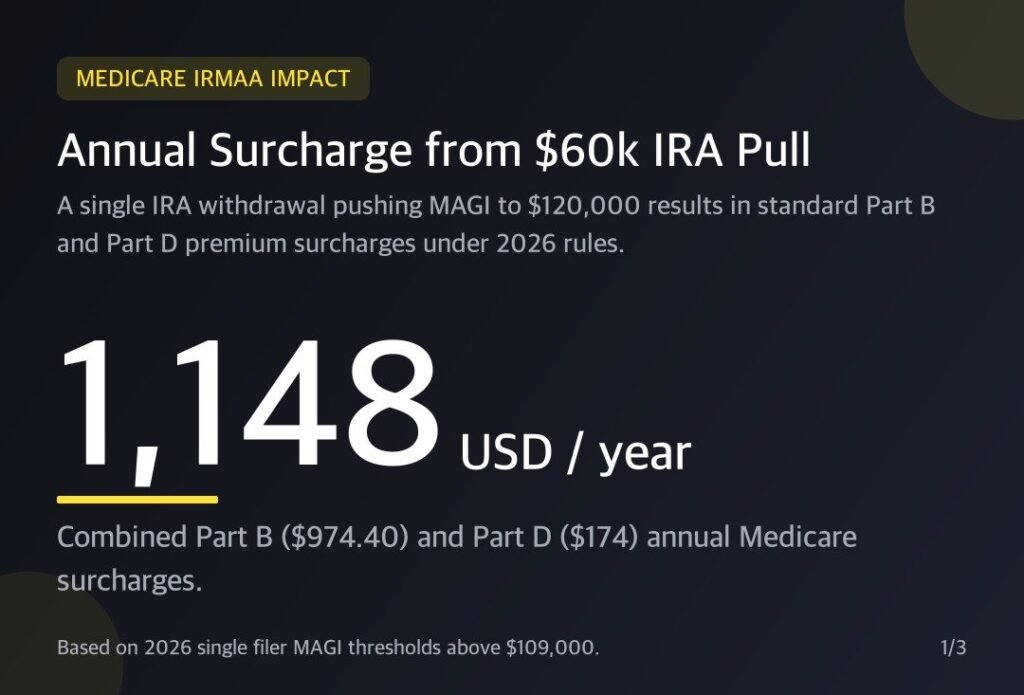

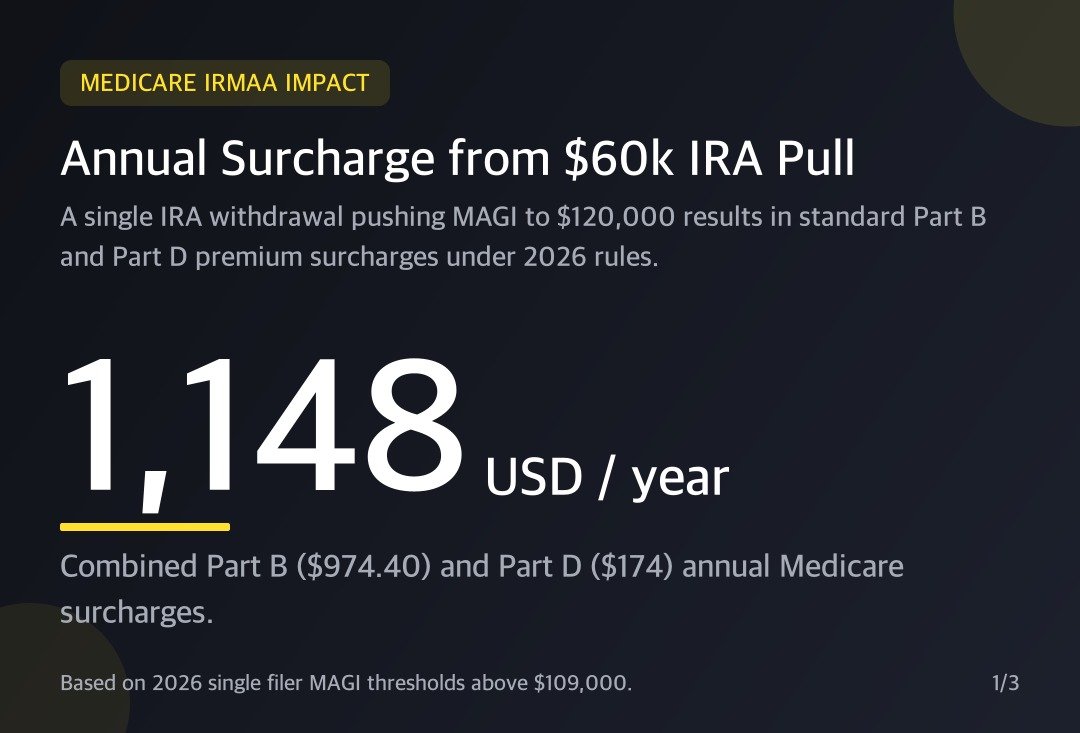
Taking a large lump-sum withdrawal from a traditional IRA can solve immediate high-interest debt, but it comes with a hidden cost for Medicare beneficiaries. Because pre-tax IRA distributions count toward Modified Adjusted Gross Income (MAGI), a sudden jump in income can trigger the Medicare Income-Related Monthly Adjustment Amount (IRMAA), leading to noticeable premium surcharges two years later.
How Traditional IRA Withdrawals Trigger Medicare IRMAA Surcharges
Every dollar withdrawn from a pre-tax traditional IRA is taxed as ordinary income. When Social Security calculates your Medicare premiums, it looks at your MAGI from your tax return two years prior (Form 1040 line 11 plus tax-exempt interest from line 2a).
If a 63-year-old earning $60,000 withdraws $60,000 from an IRA in 2026 to clear credit card debt, their MAGI rises to $120,000. Although there is no early withdrawal penalty after age 59½, that $120,000 income level directly impacts Medicare premiums when turning 65 in 2028.
Medicare Premium Costs at $120,000 Income Level
Under 2026 rules, a single filer with a MAGI of $109,000 or less pays the standard Part B premium of $202.90 per month without any surcharge. Exceeding $109,000 pushes you into higher premium tiers.
| MAGI Range (Single Filer) | Part B Monthly Premium | Monthly Surcharge | Annual Surcharge Cost |
|---|---|---|---|
| $109,000 or less | $202.90 | $0.00 | $0.00 |
| Over $109,000 up to $137,000 | $284.10 | $81.20 | $974.40 |
In addition to the Part B surcharge, a Part D prescription drug plan adds a first-tier surcharge of $14.50 per month ($174 over a full year). Together, the combined Medicare Part B and Part D surcharges total $1,148.40 per year.
Note: Rough estimates from CMS indicate that only about 8% of Part D enrollees pay IRMAA. Standard rates apply if MAGI remains at or below $109,000 for single filers or $218,000 for joint filers.
Can You Appeal the Surcharge Using Form SSA-44?
Social Security allows beneficiaries to request an IRMAA reduction using Form SSA-44, but only for specific qualifying life-changing events: * Marriage or divorce * Death of a spouse * Work stoppage or reduction in income * Loss of income-producing property * Employer settlement payment
Voluntarily taking a taxable IRA distribution to pay off credit card debt is not a qualifying life-changing event. However, if you fully stop working before age 65 and experience a permanent income drop, Social Security may use a more recent, lower MAGI figure upon request.
Comparing Credit Card Interest vs. IRMAA Surcharges
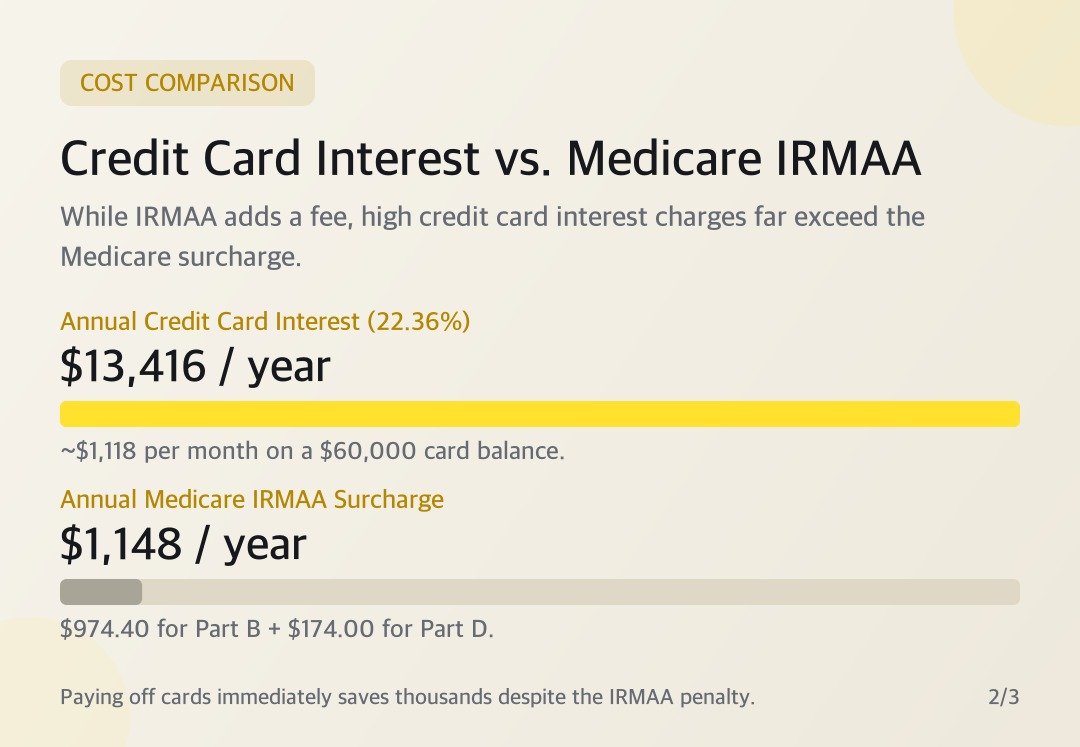
Even with an $1,148.40 Medicare surcharge, paying off high-interest credit card debt usually results in significant net savings.
With average credit card interest rates around 22.36%, carrying $60,000 in credit card debt costs roughly $13,416 per year ($1,118 per month) in interest alone. A single month of credit card interest exceeds the entire annual Part B surcharge.
3 Ways to Avoid or Lower Medicare IRMAA Surcharges
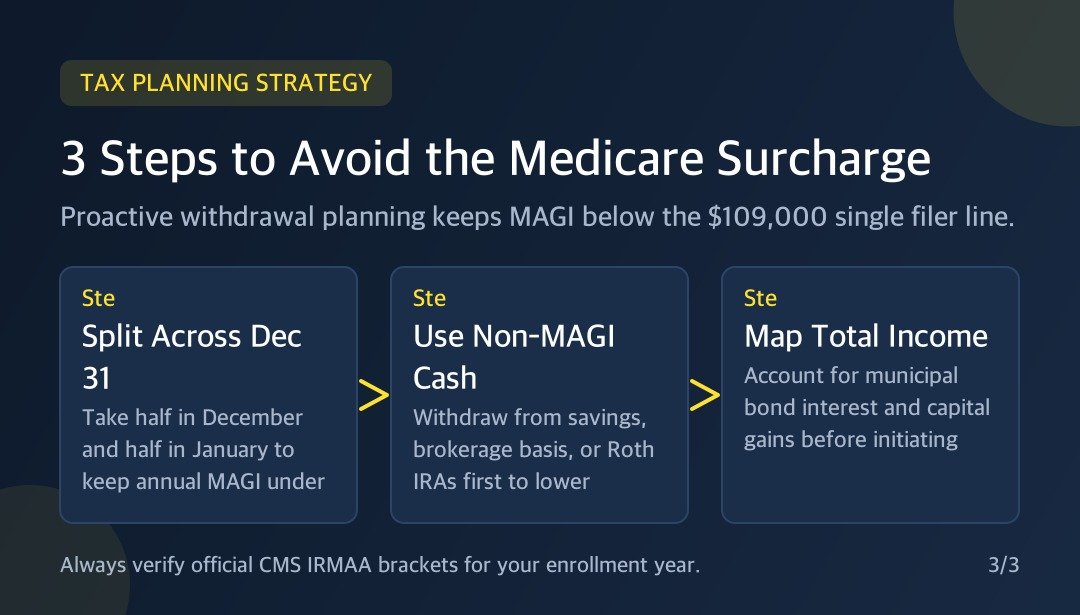
- Split the Withdrawal Across Two Tax Years: Instead of taking $60,000 in a single calendar year, take $30,000 in December and $30,000 in January. Keeping MAGI around $90,000 each year ensures you stay under the $109,000 IRMAA threshold.
- Utilize Tax-Free Cash Sources First: Use existing savings, taxable brokerage basis, or Roth IRA contributions (which come out tax-free and are excluded from MAGI) before touching pre-tax traditional IRA funds.
- Map Out Other Income: Calculate expected capital gains, home sale proceeds, or tax-exempt municipal bond interest before making IRA distributions, as these also increase MAGI for IRMAA calculations.