While most US states do not tax Social Security benefits, a select group of states still apply state income taxes to at least a portion of these retirement payments. For retirees planning their budgets and income streams, understanding where these tax rules apply can prevent unexpected state tax bills.
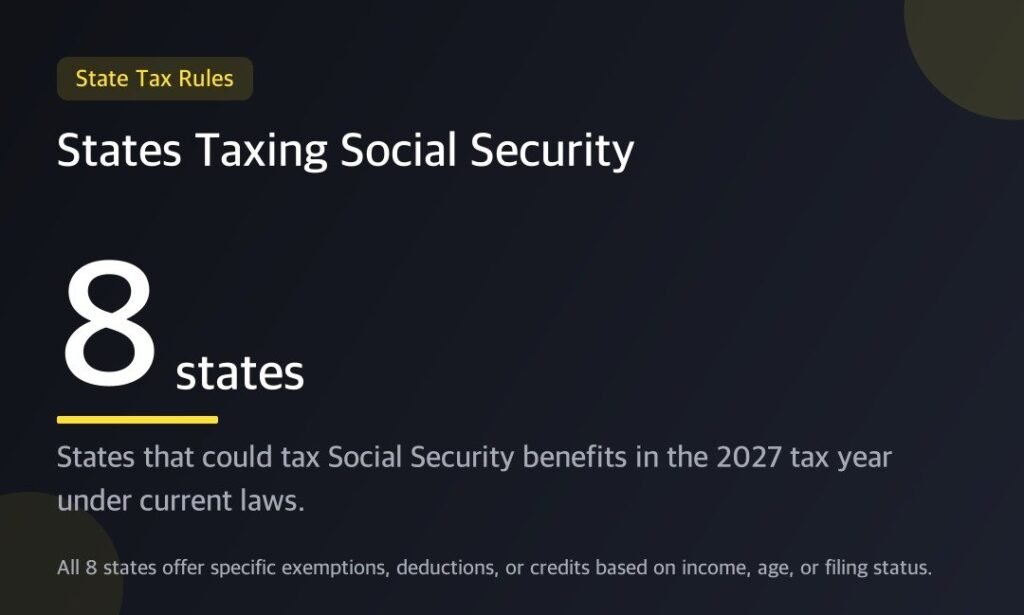
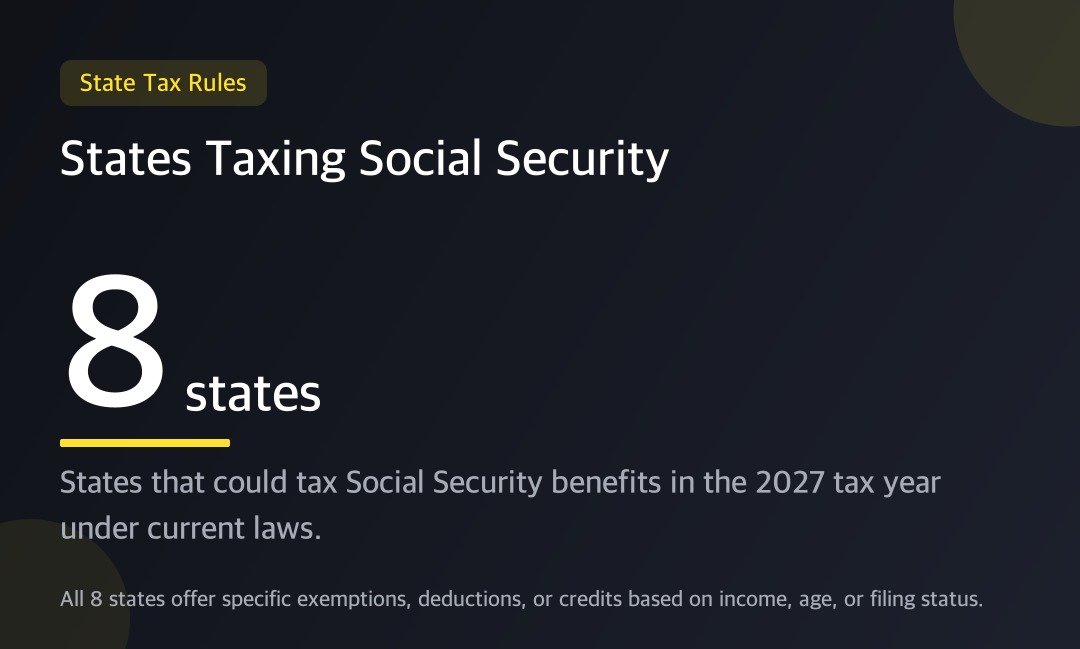
State legislatures regularly adjust thresholds, update formulas, or phase out these taxes entirely. Based on currently enacted state tax law, eight states retain taxes on Social Security benefits for the 2027 tax year, though all of them provide exemptions, deductions, or tax credits for qualifying residents.
The 8 States That Could Tax Social Security Benefits in 2027
Depending on your age, filing status, and total combined income, you may or may not owe state taxes in these jurisdictions:
- Colorado: Includes Social Security in state taxable income but offers a subtraction. Taxpayers age 65 and older can generally subtract their full federally taxable Social Security benefit, while those ages 55 to 64 may qualify for a full or capped subtraction depending on income.
- Connecticut: Taxes Social Security for higher-income residents while exempting single filers and married joint filers below specific federal adjusted gross income thresholds through a partial Benefit Adjustment calculation.
- Minnesota: Uses provisional income and adjusted gross income thresholds to phase out a state subtraction for Social Security benefits, meaning higher-income retirees with substantial pension or investment income are more likely to see a taxable portion.
- Montana: Mirrors federal rules by starting with the federally taxable amount of Social Security and applying state adjustments and deductions based on income and filing status.
- New Mexico: Exempts Social Security for most retirees under set income thresholds, but taxes benefits for higher earners using standard state income tax brackets.
- Rhode Island: Removes its prior age requirement as of January 1, 2027, basing exemptions primarily on income thresholds tied to federal adjusted gross income rather than age.
- Utah: Taxes Social Security as part of state income but offers a nonrefundable tax credit that phases out as income rises above filing-status thresholds.
- Vermont: Applies a graduated reduction in its Social Security exemption as adjusted gross income rises above specific thresholds, allowing middle-income retirees to exclude a portion of their benefits.
Key Factors Determining If You Will Owe Tax
Living in one of these eight states does not guarantee a tax bill. Multiple factors influence whether your benefits are taxed:
- Income Level & Filing Status: Most states protect lower- and middle-income retirees through sliding scales, phase-outs, or full exemptions.
- Age Requirements: Certain states tie their deductions or subtractions directly to age brackets, such as Colorado’s rules for residents 65 and older.
- Other Retirement Income: Additional income sources like pensions, part-time wages, 401(k) withdrawals, or IRA distributions often push retirees above exemption thresholds.
State Taxation vs. Federal Taxation
It is important to remember that state taxation of Social Security benefits is entirely separate from federal taxation. The federal government uses its own combined-income formula to determine federal tax liability. A retiree could owe federal tax on a portion of their benefits while owing zero state tax, or vice versa, depending on their total financial picture and place of residence.
Because state lawmakers frequently update thresholds and exemption rules, retirees should review current guidance from their state’s department of revenue or consult a qualified tax professional before filing for the 2027 tax year.