
Understanding Social Security and Farm Income
For American farmers approaching retirement while still working, managing various streams of farm-related revenue requires careful planning. If you are a farmer collecting Social Security before reaching your full retirement age (FRA), the Social Security Administration (SSA) does not treat all farm income the same way.
Crop profits, land sale gains, and water rights monetization events are categorized into three distinct income types. Each type carries different rules under the Social Security earnings test, income tax brackets, and Medicare surcharges.
How Crop Profits Impact Early Social Security Benefits
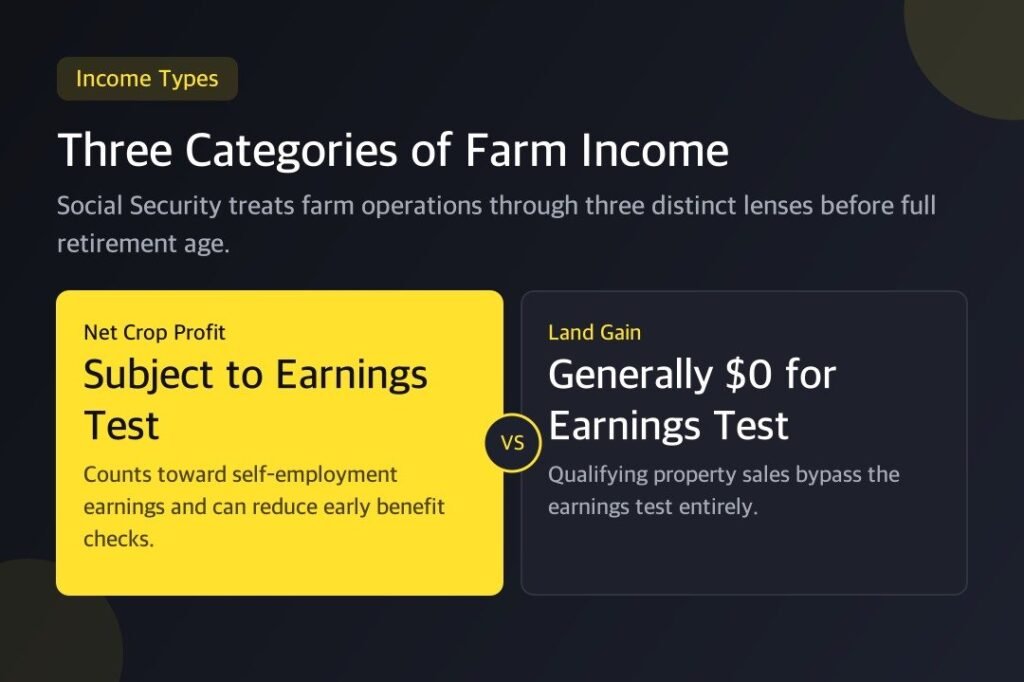
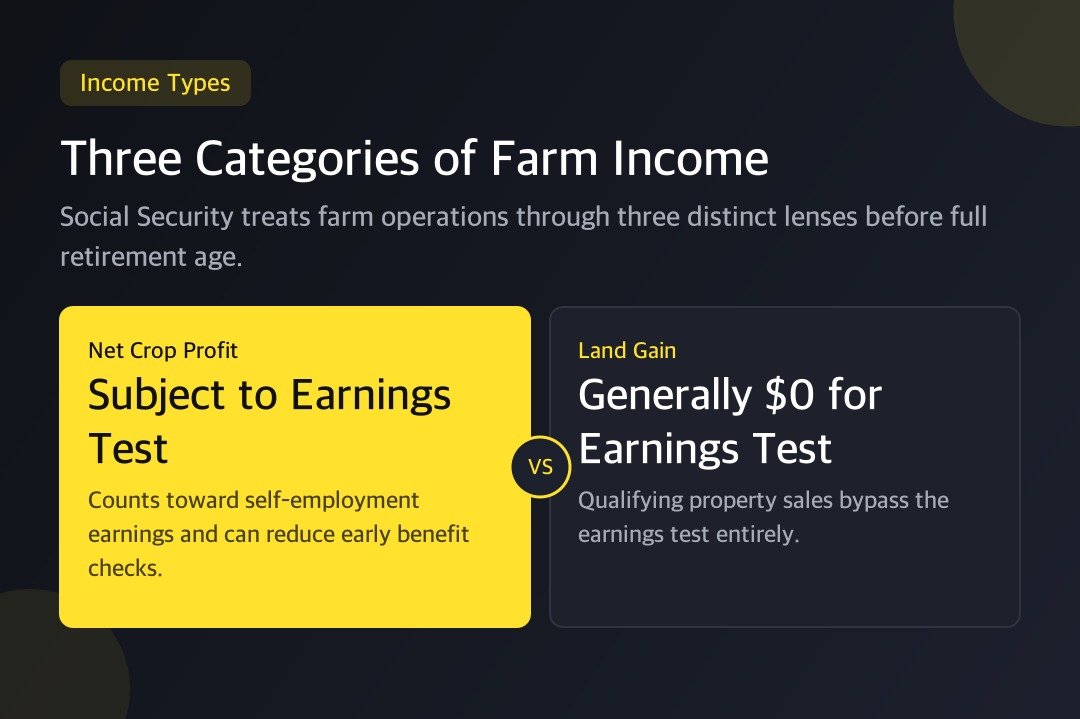
Crops raised and sold for business are treated as ordinary self-employment income. Net profits reported on Schedule F feed directly into Social Security’s earnings test.
- Calculation: Only 92.35% of net farm crop profit counts toward net earnings from self-employment.
- 2026 Earnings Limit: For beneficiaries who have not yet reached full retirement age, the earnings limit is $24,480 per year.
- Benefit Withholding: For every $2 earned above the annual limit, Social Security withholds $1 of benefits.
For example, a farmer clearing a modest $40,000 in net crop profit can trigger thousands of dollars in withheld benefits for that year. While Social Security recalculates monthly benefits at full retirement age to credit withheld months, the immediate cash flow is lost in the meantime.
Why Farmland Sales Can Count as Zero
By contrast, selling capital assets or business property not held primarily for sale to customers receives different treatment. Farmland used to grow crops typically qualifies for exclusions under the earnings test.
- Capital Gains: If you sell a parcel of land for $1 million with an adjusted basis of $500,000, your realized gain is $500,000.
- Earnings Test Exclusion: The amount counting toward the Social Security earnings test is generally $0 if it qualifies as capital or business property.
This means a modest crop profit can shrink an early benefit check, while a much larger land gain may have zero impact on the earnings test.
Water Rights and Their Third Category
Water rights tied to farmland represent a separate financial category. Depending on whether the transaction is structured as a permanent sale, a lease, or a temporary transfer, water rights gains can produce capital or business-property gains rather than ordinary crop income.
If a water rights sale qualifies for Social Security’s property-sale exclusion, the gain generally stays out of self-employment earnings. However, transactions involving permanent rights versus temporary leases are treated differently under tax and benefit rules.
Tax Implications and Medicare Premiums
Even if large land or water rights gains bypass the Social Security earnings test, they still influence adjusted gross income (AGI) and modified adjusted gross income (MAGI):
- Taxable Benefits: Up to 85% of Social Security benefits can become taxable once combined income exceeds $34,000 for single filers or $44,000 for married couples filing jointly.
- Medicare Surcharges: Income-related monthly adjustment amounts (IRMAA) begin above $109,000 of MAGI for single filers and $218,000 for joint filers in 2026. A major asset sale generally affects Medicare premiums two years later using that year’s thresholds.
Consulting a tax professional familiar with agricultural property before executing contracts helps ensure proper asset allocation between land, water, and crops.