Saving for retirement can often feel like guesswork if you do not have a concrete target. Without a specific nest egg goal, it is impossible to know whether putting away 10% of your paycheck is sufficient or merely a fraction of what you actually need. By factoring in your projected Social Security benefits and your true annual expenses, you can determine a precise savings target.
The 25x Rule and William Bengen’s Historical Study
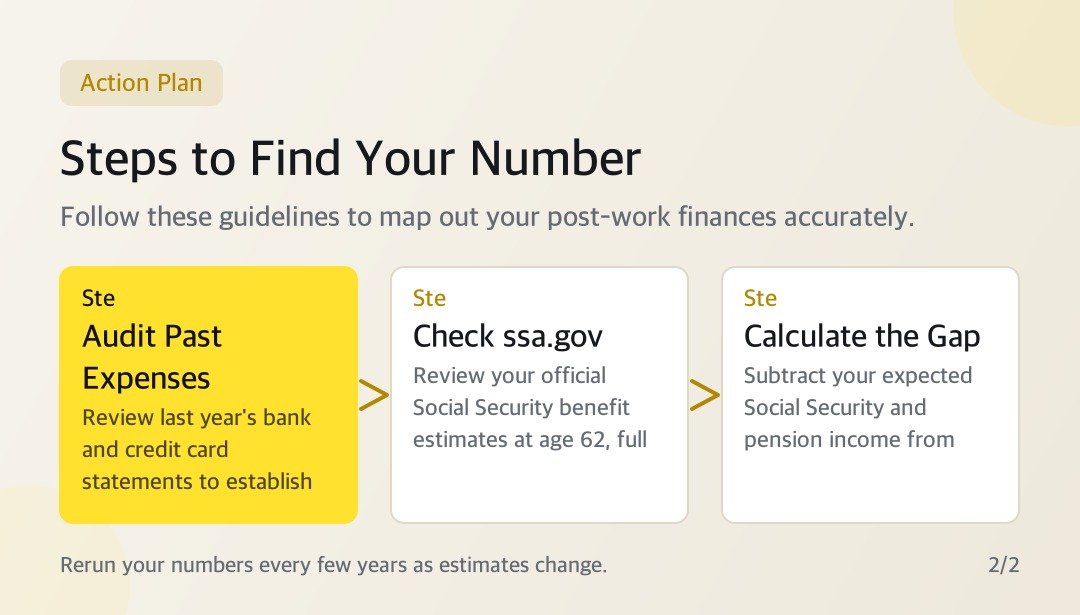
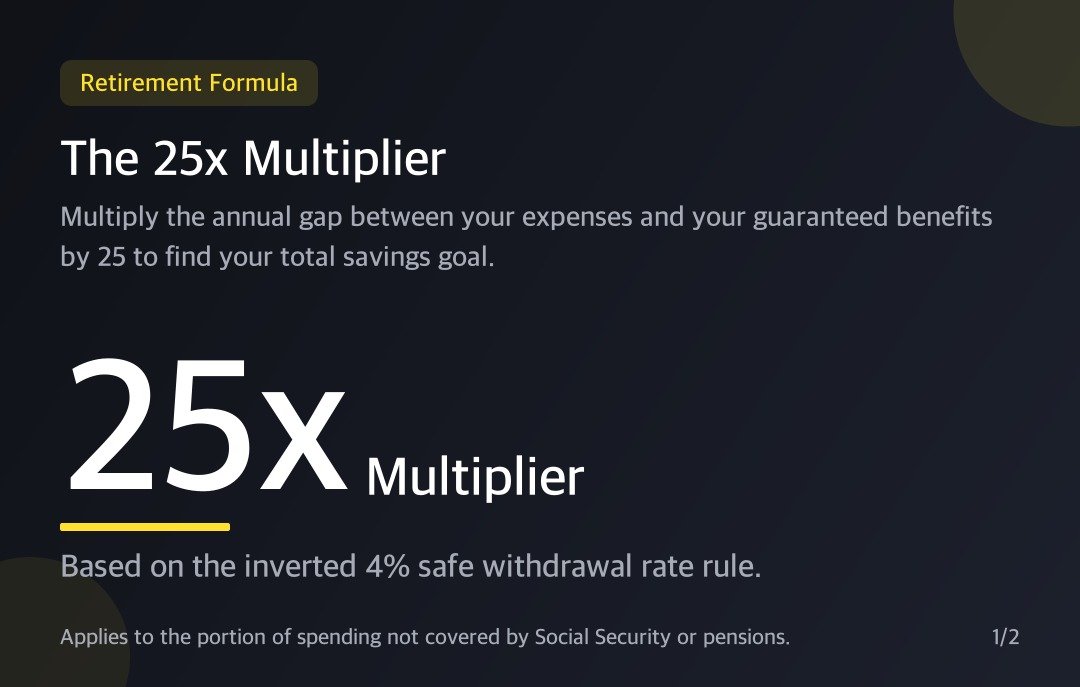
The core formula for finding your retirement number is straightforward: estimate what you will spend in a year of retirement, subtract what Social Security or a pension will pay, and multiply that gap by 25.
The multiplier of 25 is essentially the 4% rule flipped, because 4% of 25 years of spending covers a single year. This concept stems from a famous 1994 study by financial planner William Bengen, which tested U.S.
market returns dating back to 1926. In Bengen’s study, a hypothetical retiree withdrew 4% of their portfolio in the first year and subsequently adjusted that dollar amount upward to match inflation.
With a portfolio split evenly between stocks and Treasury notes, the funds lasted for a minimum of 33 years across every historical period studied.
Why You Should Subtract Social Security First
A common mistake is multiplying your total expected gross spending by 25. Only the portion of your expenses that Social Security or a pension will not cover requires the 25x multiple.
- The Full-Total Pitfall: For example, if a couple expects to spend $70,000 a year and multiplies that entire amount by 25, they arrive at a target of $1.75 million.
- The Correct Approach: If Social Security covers $30,000 of that $70,000 annual need, the gap is only $40,000. Multiplying that $40,000 gap by 25 yields a target of $1 million—saving them from overshooting their goal by $750,000.
How to Calculate Your Annual Retirement Spending
To make this calculation accurate, you must start from your actual spending rather than your current salary. Your current paycheck goes toward items that disappear in retirement, such as payroll taxes and active retirement contributions. Conversely, you must count income taxes on traditional 401(k) and IRA withdrawals as part of your future spending.
Do not automatically assume your living expenses will drop significantly once you stop working. An Employee Benefit Research Institute study revealed that nearly half of households actually spent more money in their first two years of retirement than they did immediately before retiring. To get a realistic baseline, pull your bank and credit card statements from last year and tally up your actual out-of-pocket expenses.
Factoring in Social Security and Early Retirement Timelines
To figure out the Social Security side of the equation, log into your account at ssa.gov to review your estimated benefits. The Social Security Administration provides benefit projections for whether you choose to claim at age 62, your full retirement age, or age 70. Be sure to add any private or public pension income to this figure.
Keep in mind that the standard 25x rule assumes a traditional mix of stocks and bonds alongside approximately 30 years of withdrawals. If you plan on retiring in your 50s or earlier, your savings may need to last for 40 years or more, meaning you should use a higher multiple than 25.
Once you have calculated your target nest egg, plug that figure into a reliable retirement calculator along with your current savings and timeline to find out how much you need to save each month. Because spending plans and Social Security estimates fluctuate over time, it is best to rerun your numbers every few years.