Your 2026 Social Security payment date depends on your birth date and the type of benefit you receive — most retirees, disabled workers, and survivors are paid on a Wednesday tied to their birth date, while SSI recipients are paid on the 1st of each month. Here’s exactly how the schedule works and what to do if your payment doesn’t show up.
How Your Payment Date Is Determined
The Social Security Administration (SSA) doesn’t hand out payment dates randomly. Your check — or more accurately, your direct deposit — arrives based on two things: the type of benefit you receive, and for most people, your birth date.
For retirement, Social Security Disability Insurance (SSDI), and survivor benefits, the SSA’s official 2026 calendar splits beneficiaries into three groups by birth date:
- Born on the 1st–10th of the month: paid on the second Wednesday
- Born on the 11th–20th: paid on the third Wednesday
- Born on the 21st–31st: paid on the fourth Wednesday
There are two notable exceptions. If you started receiving benefits before May 1997, your payment typically arrives on the 3rd of each month regardless of your birth date. And if you receive Supplemental Security Income (SSI), payments are generally issued on the 1st of each month rather than following the Wednesday system at all.
One detail worth flagging: if you receive both SSI and Social Security retirement benefits, you’ll likely get two separate deposits each month on two different dates — one for each program.
Who Gets Paid When: The 2026 Schedule
Applying the SSA’s birth-date rule to the actual 2026 calendar, here’s which Wednesday each group falls on, month by month. These are the standard dates before any holiday adjustment (see the note below the table):
| Month | 2nd Wed (born 1–10) | 3rd Wed (born 11–20) | 4th Wed (born 21–31) |
|---|---|---|---|
| January | 14 | 21 | 28 |
| February | 11 | 18 | 25 |
| March | 11 | 18 | 25 |
| April | 8 | 15 | 22 |
| May | 13 | 20 | 27 |
| June | 10 | 17 | 24 |
| July | 8 | 15 | 22 |
| August | 12 | 19 | 26 |
| September | 9 | 16 | 23 |
| October | 14 | 21 | 28 |
| November | 11 | 18 | 25 |
| December | 9 | 16 | 23 |
If any of these dates falls on a weekend or federal holiday, the SSA moves the payment to the preceding business day — the source article gives a real example of this from earlier in 2026, when an SSI payment originally scheduled for Sunday, March 1 was instead paid on Friday, February 27. Because holiday-driven shifts aren’t listed here, check the SSA’s official published calendar for the confirmed, adjusted date for your specific month before you rely on it for bill payments.
For SSI recipients and for anyone who started benefits before May 1997, the rule is simpler: the 1st or 3rd of the month, respectively, adjusted the same way if it lands on a weekend or holiday.
Payment Amounts and the 2026 COLA
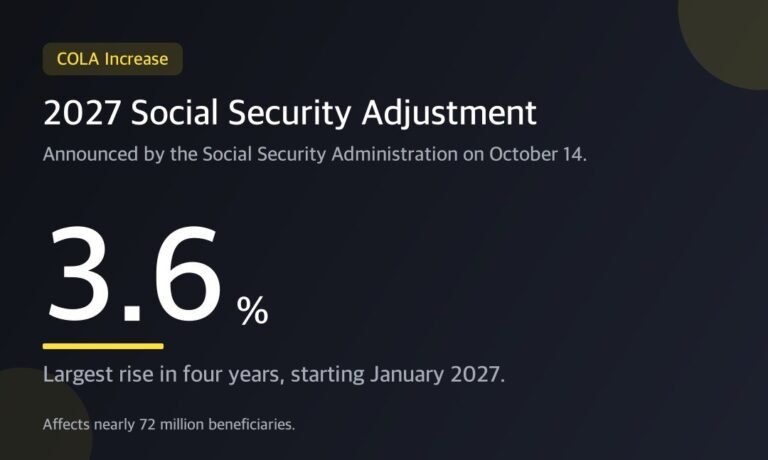
The article doesn’t provide individual benefit amounts — those are personal and vary by earnings history, benefit type, and claiming age, so there’s no single “how much” figure that applies to everyone. What is confirmed is the annual cost-of-living adjustment (COLA), which determines how much benefit amounts increase each year based on the Consumer Price Index. For 2026, Social Security beneficiaries and SSI recipients received a 2.8% COLA increase. COLA increases are typically announced in the fall and take effect the following January, so if you want to know exactly how your specific payment changed, check the notice the SSA sent you or your “my Social Security” account rather than assuming a generic figure.
What to Do If Your Payment Is Late or Missing
If your payment doesn’t arrive on the expected date, the SSA’s own guidance is not to panic immediately — it recommends waiting three business days before reporting a missing payment. If it still hasn’t shown up after that:
- Check your bank account or contact your financial institution directly — processing delays on the bank’s end are a common cause.
- Confirm the expected date against the official SSA payment calendar, since holidays and weekends shift dates.
- Log into your “my Social Security” account at SSA.gov to review your payment status.
- If the issue persists, contact the SSA directly at 1-800-772-1213 or visit your local Social Security office.
Common causes of delays include federal holidays, bank processing issues, and administrative errors — the last of which is often tied to outdated personal information. If you’ve moved or switched bank accounts, updating that information with the SSA promptly is one of the more effective ways to avoid a delay.
It’s also worth noting that Social Security benefits are considered mandatory federal spending, and the source reports they have historically continued to be paid on time even during temporary government funding lapses — so a shutdown in Washington isn’t, by itself, a reason to expect your payment to be late.
Managing Your Benefits: Direct Deposit and Your Online Account
As of September 30, 2025, federal law requires that all federal benefit payments — including Social Security and SSI — be made electronically under Executive Order 14247, “Modernizing Payments To and From America’s Bank Account.” Paper checks are being phased out for most recipients; there are limited exceptions, but they require submitting and being approved for a waiver.
If you’re still receiving a paper check, switching to direct deposit (or a government-issued debit card if you don’t have a bank account) is faster, more secure, and now required in most cases. You can set this up or update your information through your “my Social Security” account at SSA.gov.
Setting up that account is worth doing even if you’re already on direct deposit — it lets you manage your benefits, request a replacement Social Security card, and opt into online notices, which gives you access to your annual COLA notice and tax forms up to three weeks earlier than they’d arrive by mail.
FAQ
Can I switch to direct deposit if I still get a paper check?
Yes, and as of the federal electronic-payment mandate, you’re generally required to. Log into your “my Social Security” account at SSA.gov or contact the SSA directly to set it up.
Is SSI paid on the same schedule as Social Security retirement benefits?
No. SSI is generally paid on the 1st of each month, while retirement, disability, and survivor benefits follow the second/third/fourth Wednesday system based on birth date. If you receive both, expect two separate payments on different dates.
How do I find my exact payment date if it changes for a holiday?
Review the official SSA payment calendar at SSA.gov, or check your “my Social Security” account — that’s the confirmed source rather than relying on estimates.
What if I started receiving benefits before May 1997 — does the Wednesday rule apply to me?
No, that group is generally paid on the 3rd of each month regardless of birth date.
Will a government shutdown delay my Social Security payment?
Social Security is classified as mandatory spending and has historically continued to be paid on time during past shutdowns, according to the source article. For the most current information during any specific funding situation, check official SSA announcements.