
The Social Security Administration terminology for retirement age benefits is getting a major overhaul. Congress passed the Claiming Age Clarity Act, bipartisan legislation now awaiting President Donald Trump’s signature, designed to clear up confusing official language surrounding when you claim your benefits.
While the bill changes official terms, it does not alter actual retirement ages or work requirements. Instead, it renames key age thresholds to clearly show how your claiming age directly impacts your monthly Social Security payment.
Why Social Security Terminology Is Changing
For years, terms like "Full Retirement Age" or "Early Eligibility Age" have created confusion among future retirees. Many people mistakenly assume "Full Retirement Age" is the absolute maximum age or the mandatory age to claim benefits.
Introduced in the House by Rep. Lloyd Smucker (R-Pa.) and Rep.
Don Beyer (D-Va.), the legislation updates government terminology with clear language so Americans understand how claiming early or delaying affects monthly payout amounts. The bill received bipartisan support and endorsement from groups such as AARP, Bipartisan Policy Center Action, and AMAC Action.
What Are the New Social Security Age Terms?
The Claiming Age Clarity Act replaces three primary Social Security retirement age terms:
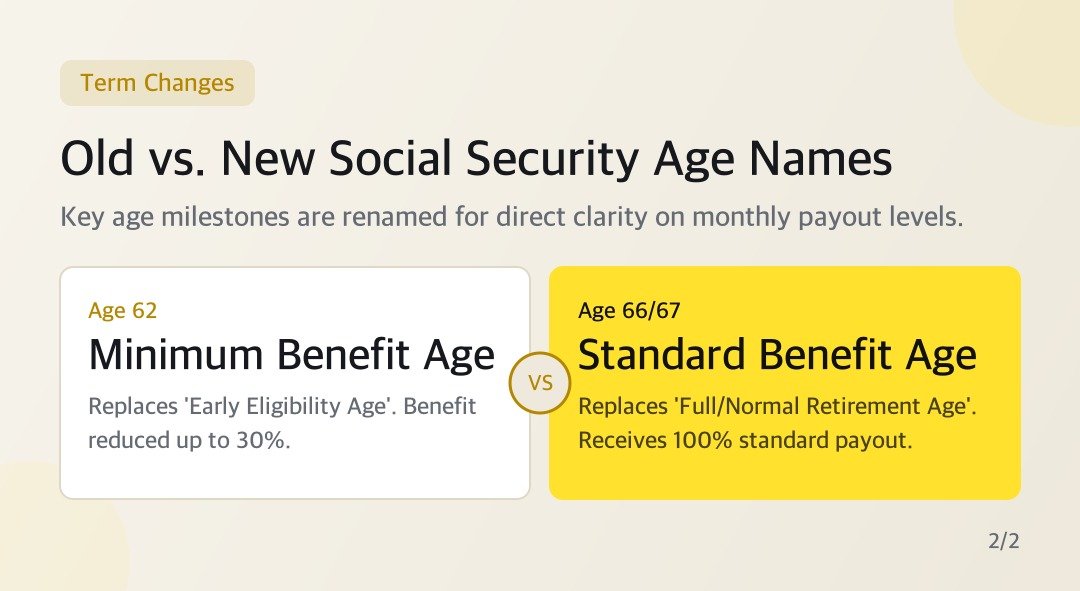
- Minimum Benefit Age (formerly Early Eligibility Age):
- Age: Starts at age 62, the earliest you can claim retirement benefits.
- Impact: Claiming at age 62 permanently reduces your monthly check by as much as 30% compared to waiting for standard benefit age.
- Standard Benefit Age (formerly Full Retirement Age and Normal Retirement Age):
- Age: Generally age 66 or 67, depending on your birth year.
- Impact: Entitles you to 100% of your standard benefit. For every year you delay past this age, your payout grows roughly 8% per year up to age 70.
- Maximum Benefit Age (formerly Delayed Retirement Age):
- Age: Reached at age 70, the latest age to begin claiming.
- Impact: Delaying until age 70 yields the largest possible monthly check—up to 24% higher than your standard benefit.
How the New Terms Impact Your Retirement Choices
| New Term | Former Term | Target Age | Monthly Benefit Impact |
|---|---|---|---|
| Minimum Benefit Age | Early Eligibility Age | Age 62 | Reduced up to 30% |
| Standard Benefit Age | Full / Normal Retirement Age | Age 66 or 67 | 100% of standard earned benefit |
| Maximum Benefit Age | Delayed Retirement Age | Age 70 | Increased up to 24% above standard |
These updated labels do not force you to work longer or change when you are permitted to claim. They simply provide clearer, more direct language to help you make informed decisions about your Social Security retirement strategy.